

What Is a Prescription Drug Screening Test? A Complete UK Guide
This article is for general educational purposes only and does not constitute legal or medical advice. If you take prescribed medication, never stop or change your dose without first speaking to your GP or pharmacist.

A prescription drug screening test is a urine, saliva, blood or hair test that checks for medicines that are legally prescribed but can also be misused, such as opioid painkillers, benzodiazepines and nerve-pain medicines like pregabalin and gabapentin. It works in the same way as any other drug screen, but its panel is built around the prescription drug groups that a standard drug test often misses.
Prescription drug screening is used by employers, healthcare teams, drug treatment services and families across the UK. This guide explains what a prescription drug screening test looks for, how it works, how long common medicines stay detectable, how UK drug driving law treats prescribed medicines and how to choose the right test kit. Above all, a positive screening result is not proof of misuse, and it should always be confirmed by a laboratory before any decisions are made.
What does a prescription drug screening test look for?
Most prescription drug screening tests target the medicine groups with the highest potential for dependence or impairment. Each group appears on a test kit as a short code printed beside its result window, so it helps to know the codes before you buy or read a test.
| Prescription drug group | Common examples | Usually prescribed for | Test panel code | Typical urine detection window |
| Opiates | Codeine, dihydrocodeine, morphine | Pain, persistent cough | OPI / MOP | 1–3 days |
| Oxycodone | Oxycodone | Moderate to severe pain | OXY | 1–3 days |
| Tramadol | Tramadol | Moderate to severe pain | TML | 1–4 days |
| Fentanyl | Fentanyl | Severe or long-term pain, often as skin patches | FYL | 1–3 days |
| Buprenorphine | Buprenorphine | Pain, treatment of opioid dependence | BUP | 1–6 days |
| Methadone | Methadone | Treatment of opioid dependence | MTD / EDDP | 1–8 days |
| Benzodiazepines | Diazepam, lorazepam, temazepam, clonazepam | Anxiety, insomnia, seizures, muscle spasm | BZO | 1–4 days (up to 30 days with regular use of long-acting types) |
| Gabapentinoids | Pregabalin, gabapentin | Nerve pain, epilepsy, anxiety | PGB / GAB | 1–3 days (up to 5 days) |
| Barbiturates | Phenobarbital | Epilepsy | BAR | 1–8 days |
| Tricyclic antidepressants | Amitriptyline, nortriptyline | Depression, nerve pain | TCA | 2–7 days |
| Amphetamine-based medicines | Dexamfetamine, lisdexamfetamine | ADHD, narcolepsy | AMP | 1–4 days |
These detection windows are averages taken from our test kit data sheets. Actual times vary with the dose, how often the medicine is taken, metabolism and kidney function. For a fuller breakdown, see our guide to drug test detection times and cut-off levels.
Why a standard drug test is not always a prescription drug screening test
A typical 5 panel urine drug test screens for cannabis, cocaine, opiates, amphetamine and benzodiazepines (or methamphetamine). That will pick up some prescribed medicines, such as codeine, morphine and diazepam, but many of the prescription drugs most commonly misused in the UK will not show up on a standard panel at all.
- Tramadol is chemically different from morphine and codeine, so a standard opiate test rarely detects it. Our guide will tramadol show up on a drug test? explains why.
- Oxycodone is often missed by opiate panels at normal prescribed doses, so it needs its own OXY test.
- Buprenorphine and fentanyl are synthetic opioids that need dedicated BUP and FYL panels.
- Pregabalin and gabapentin are neither opioids nor benzodiazepines, so they need specific PGB and GAB tests.
If prescription medicines are a concern, always check the drug list on a kit before you buy. Our article on what drugs don't show up on a standard UK drug test covers the gaps in more detail.
How does a prescription drug screening test work?
Prescription drug screening in the UK normally follows a two-step process: a rapid screening test first, followed by laboratory confirmation of anything that isn't clearly negative.
Step 1: Rapid screening. On-site drug test cups, dip cards, single test strips and saliva swabs use a method called immunoassay. Antibodies on the test membrane react with the drug, or its breakdown products (metabolites), in the sample. If the level is above the test's cut-off, the test line for that drug does not form. A control line with no test line means a non-negative result for that drug group, while two lines mean negative. Results are usually ready in five to ten minutes.
A screening test tells you whether a drug group is present above the cut-off. It cannot tell you which specific medicine was taken, how much, when, or whether it was taken as prescribed. Our guide on how to read drug test results explains what each line means.
Step 2: Laboratory confirmation. Any non-negative screen should be sent to a UKAS-accredited laboratory for LC-MS/MS analysis (liquid chromatography with tandem mass spectrometry). This identifies the exact drug and its metabolites and measures how much is present, which is what allows a result to be checked against a declared prescription.
Who uses prescription drug screening tests in the UK?
- Employers in safety-critical industries such as rail, construction, transport and logistics, where sedating painkillers or tranquillisers could put workers and the public at risk. Our page on drugs in the workplace in the UK covers the wider picture, and our workplace drug testing kits are chosen with these sectors in mind.
- Pain clinics and other healthcare settings, to check that patients on long-term medicines are taking them as prescribed and are not adding other drugs on top.
- Drug and alcohol treatment services, to confirm that people on methadone or buprenorphine treatment are taking their medicine and to check for use of other opioids.
- Prisons, probation and the wider criminal justice system, where misuse of medicines such as pregabalin and gabapentin is a recognised problem.
- Families and individuals worried about a loved one's use of prescribed or illicitly obtained medicines, using home drug testing kits.
Did you know? A Public Health England review found that in 2017 to 2018, around one in four adults in England (11.5 million people) had at least one prescription dispensed for a benzodiazepine, z-drug, gabapentinoid, opioid painkiller or antidepressant. Read the prescribed medicines review summary on GOV.UK.
Prescription drug screening test types: urine, saliva, blood and hair
The sample you test changes both the drugs you can screen for and how far back the test can see.
| Sample type | Typical detection window | Best for |
| Urine | 1–4 days for most prescription drugs, longer for some benzodiazepines | Workplace, clinical and home screening, with the widest choice of prescription drug panels |
| Saliva | Usually up to around 48–72 hours | Observed collection and detecting more recent use |
| Blood | Hours to around 1–2 days | Laboratory testing in hospitals and police drug driving investigations |
| Hair | Up to around 90 days | Laboratory testing of longer-term use, for example in court cases |
For most people, urine is the most practical sample for prescription drug screening, because it offers the longest on-site detection window and the widest range of prescription drug panels. Our 12 panel workplace cup screens for pregabalin, tramadol, buprenorphine, methadone (via its EDDP metabolite) and benzodiazepines alongside the common street drugs, with a built-in adulteration strip and temperature check.

Where you need to watch the sample being collected, a saliva test removes the need to handle urine. Our 6 + 6 direct saliva kit combines two swab tests to screen for 12 drug groups, including oxycodone, tramadol, methadone, benzodiazepines and fentanyl.

You can compare other oral fluid options in our multi-panel saliva drug test kits range.
Testing for a single prescription drug
Sometimes you only need to check for one medicine, for example a clinic monitoring a patient on pregabalin, or a family worried about a relative's use of sleeping tablets. In these cases a single-drug test strip is quicker, simpler and cheaper than a full multi-panel test.

Benzodiazepine test strips detect a wide range of medicines in this group, including diazepam, lorazepam, temazepam and clonazepam. Bear in mind that a benzodiazepine strip will not tell you which specific benzodiazepine is present, only that the group has been detected above the cut-off.

Browse our full range of single urine drug test strips to find tests for other individual medicines.
Which prescription drug screening test kit should you choose?
The right prescription drug screening test depends on which medicines matter in your setting, not simply on the number of panels. A rail contractor may need pregabalin and tramadol, a pain clinic may need oxycodone and fentanyl, and a treatment service will want buprenorphine and methadone. If you need the broadest possible screen in a single cup, our 18 panel ultra sensitive cup covers oxycodone, fentanyl, buprenorphine, methadone, tramadol, barbiturates, tricyclic antidepressants and benzodiazepines, as well as the common street drugs.
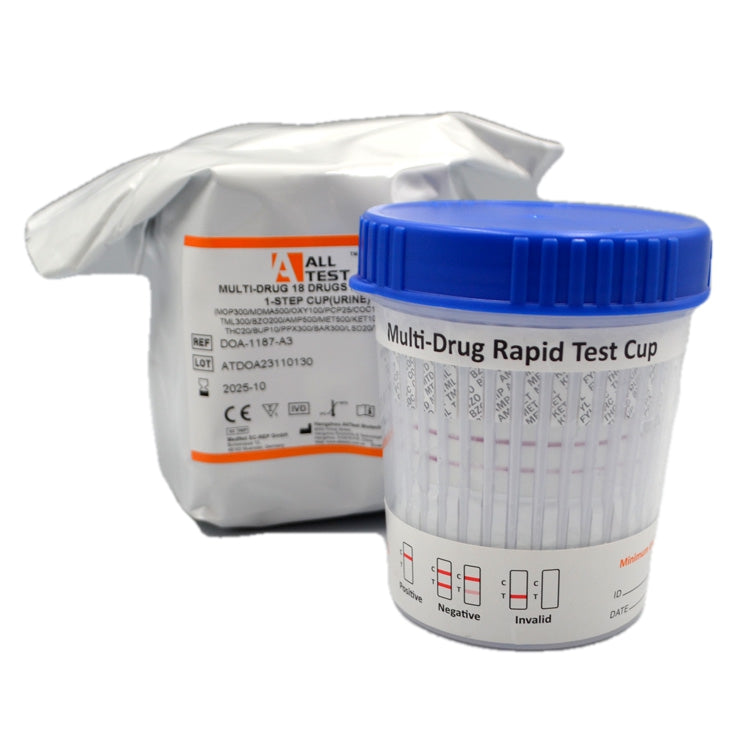
Use the table below to match a test to your needs:
| Prescription drug screening test | Best for |
| 12 panel workplace and railside urine cup | Workplace screening that adds pregabalin, tramadol, buprenorphine and methadone to common street drugs, with anti-tamper checks built in |
| 10 panel workplace urine dip test (TRAM/KET) | A lower-cost workplace test that adds tramadol and ketamine to the standard drug groups |
| 18 panel ultra sensitive urine cup | The broadest single-cup screen, including oxycodone, fentanyl, barbiturates and tricyclic antidepressants |
| 6 + 6 direct saliva test for 12 drugs | Observed collection without handling urine, including oxycodone, tramadol and methadone |
| Single urine drug test strips | Checking for one specific medicine at the lowest cost |
| UKAS laboratory confirmation urine pack | Confirming any non-negative screen with LC-MS/MS before action is taken |
Will prescribed medication show up on a prescription drug screening test?
Yes. If a medicine is on the test panel and its level is above the cut-off, it will produce a non-negative result whether it was prescribed or not. A screening test cannot tell the difference between someone taking their medicine exactly as directed and someone misusing it.
That is why good practice is to ask the person being tested to declare any prescribed or over-the-counter medicines before the test, so a non-negative result can be interpreted fairly. Workplace testing in the UK should be carried out with informed consent and under a clear written policy. Our guide to writing a drug and alcohol policy and our drug testing record and consent form for employers are a good place to start. Information about someone's medication is health data, a special category of personal data under UK GDPR, so it should only be collected when needed and kept confidential.
A few points to be aware of:
- Over-the-counter painkillers containing codeine will legitimately trigger an opiate result.
- Some antidepressants and antipsychotics are known to cross-react with certain immunoassay panels and can cause a false positive drug screen.
- Never stop or reduce a prescribed medicine to pass a drug test. Stopping some of these medicines suddenly, particularly benzodiazepines, opioids and gabapentinoids, can cause serious withdrawal effects. Speak to your GP or pharmacist first.
What happens after a positive prescription drug screening test?
A non-negative screen is a presumptive result only. No disciplinary, clinical or family decisions should be based on it alone. The next step is to send a sample, collected under chain of custody, to a UKAS-accredited laboratory for confirmation. The laboratory report identifies the specific drug and its metabolites and measures the levels present, which can then be compared with any declared prescription, ideally with input from a medical review officer or occupational health professional.
Our UKAS laboratory confirmation urine pack can confirm prescription drug groups including tramadol, gabapentinoids, oxycodone, buprenorphine, methadone, benzodiazepines, opiates and barbiturates, with samples typically processed within three to five working days of reaching the laboratory.

See all our laboratory confirmation drug test packs, including saliva options.
Prescription drug screening tests and UK drug driving law
Since 2 March 2015, it has been an offence in England and Wales to drive with certain drugs in your body above a specified limit. Eight of the drugs covered are medicines: clonazepam, diazepam, flunitrazepam, lorazepam, oxazepam, temazepam, methadone and morphine. Scotland introduced its own version of the offence on 21 October 2019.
For most of these medicines, the limits were set above the levels normally seen in people taking them as prescribed. If you are found over a limit, there is a medical defence where the medicine was prescribed or supplied to you, you took it in line with the advice of your prescriber or the patient leaflet, and your driving was not impaired. The medical defence does not apply to the separate offence of driving while impaired by drugs, so if a medicine makes you drowsy or affects your driving, you should not drive.
Roadside saliva kits currently screen for cannabis and cocaine, but police can require a blood sample at the station that is analysed for other drugs, including prescription medicines. Find out more on GOV.UK and in our guide to UK drug driving tests.
Prescription drug screening test: frequently asked questions
What is the difference between a standard drug test and a prescription drug screening test in the UK?
A standard drug test focuses on common illegal drugs such as cannabis and cocaine. A prescription drug screening test adds panels for medicines that can be misused, such as tramadol, oxycodone, pregabalin, gabapentin, buprenorphine and fentanyl, which a standard panel would usually miss.
Does a 5 panel drug test detect prescription drugs?
Partly. A 5 panel test will usually detect codeine and morphine on its opiate panel, and benzodiazepines if that panel is included, but it will not normally detect tramadol, pregabalin, gabapentin, fentanyl or buprenorphine, and it often misses oxycodone.
How long do prescription drugs stay in your system for a urine drug test?
Most prescription drugs are detectable in urine for around one to four days. Methadone and barbiturates can be detected for up to around eight days, and long-acting benzodiazepines such as diazepam can be detected for up to 30 days with regular use.
Do I have to tell my employer about prescribed medication before a workplace drug test in the UK?
This depends on your employer's drug and alcohol policy, and safety-critical roles often have stricter rules. Most policies ask employees to declare medicines that could affect safety or show on a test, and declaring them confidentially before testing helps make sure a non-negative result is interpreted fairly.
Can a prescription drug screening test show if someone is taking more than their prescribed dose?
Not on its own. Rapid screening tests only give a positive or negative result. A laboratory LC-MS/MS test measures drug levels, but urine concentrations are affected by hydration, timing and metabolism, so interpreting them against a prescription needs clinical input.
Can I do a prescription drug screening test at home in the UK?
Yes. Urine test cups, dip cards and single-drug strips are simple to use at home and give results in minutes. For anything with legal, employment or medical consequences, a non-negative result should be confirmed by an accredited laboratory.
The takeaway: a prescription drug screening test is only as useful as its panel. Check which prescription drug groups a kit actually covers, ask for medication to be declared before testing, and confirm every non-negative screen with a UKAS-accredited laboratory test before acting on it.

The information in this article is provided for general educational purposes only and does not constitute legal or medical advice. Drug driving limits, drug classifications and workplace testing guidance can change over time, so always check current UK legislation or seek professional advice if you need definitive guidance.
Point-of-care prescription drug screening tests are screening tests only. Any non-negative result should be confirmed using an accredited laboratory confirmation drug test before any decisions or actions are taken based on the result.
Never stop, reduce or change a prescribed medicine without advice from your GP or pharmacist. If you have concerns about your own or someone else's use of prescription medicines, please speak to a healthcare professional or a local drug and alcohol support service.