Drug Test Results
How to read drug test results
Every drug test gives one of three results: negative, positive or invalid. To read yours, look at the two lines in the result window: the control line (C) and the test line (T).
A negative result means no drug was found above the cut-off level. The cut-off level is the amount of a drug needed to give a positive result. A positive result means the test detects drug levels above the cut-off.
Home and workplace kits are screening tests, so a positive is only a preliminary result. It should be confirmed with a laboratory test before any decisions are made.
What to check before you read your drug test results
Once you've taken the test, drug test results must be read at the time given in your kit's instructions. This read time is different for each kit.
- Don't read the result too early. The lines may not have finished forming.
- Don't rely on lines that appear after the read time has passed. These are sometimes called ghost lines, and they aren't reliable.
- Check the C line first. If it's missing, the result is invalid.
How to read urine and saliva drug test results
There are two main types of tests: urine tests (such as cups and dip cards) and saliva tests. Urine and saliva tests are read the same way, so this guide works for either.
Some kits test for one type of drug only. Multi-panel kits test for several at once, with a separate result for each drug.
Drug test results at a glance: negative, positive, faint line and invalid
| Result | What you'll see | What it means |
|---|---|---|
| Negative | C line and T line | No drug found above the cut-off level |
| Positive | C line only (no T line) | Drug found above the cut-off level. Confirm with a lab test |
| Faint T line | C line and a faint T line | Negative |
| Invalid | No C line | The test hasn't worked. Repeat with a new kit |
What does a negative drug test result look like?
If both a C line and a T line appear within the read time, the result is negative. No drug was found above the cut-off level.
What does a positive drug test result look like?
If a C line appears but there's no T line, the result is positive. This can feel the wrong way round, but it's how these tests work. When a drug is present above the cut-off, it stops the T line from forming.
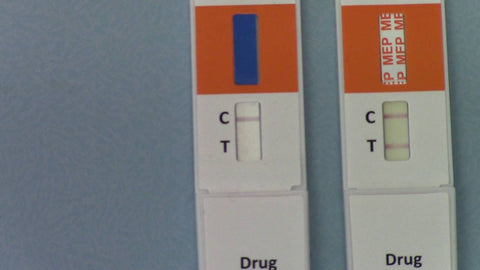
Example of positive and negative drug test results
The image below shows two results:
- The first is positive. The C line is there, but the T line is missing.
- The second is negative. Both the C line and the T line are there.
What should you do after a positive drug test result?
- Don't make a decision based on the screening test alone.
- Confirm the result with a laboratory drug test.
- Ask about any medicines the person is taking, as some can cause a false positive.
Is a faint T line on a drug test negative?
Yes. A faint T line with a visible C line is still a negative result, as long as it appeared within the read time. It doesn't matter how faint the line is, because any T line counts.
A faint line can appear when there's a small amount of a drug in the sample that's below the cut-off level. It can also simply be down to normal variation between tests. You can't use a faint line to work out how much of a drug is in the sample.
Find out more about a faint line on a drug test
What does an invalid drug test result mean?
If no C line appears, the result is invalid, even if there is a T line. The test hasn't worked, so you'll need to repeat it with a new kit.
The two most common causes are:
- Not enough sample. The kit needs enough urine or saliva to work properly. This is more common with saliva tests, where it's easy to collect only a small amount.
- The cover wasn't removed. Most urine panel tests and direct saliva tests have a cover that must come off before use. If it's left on, the kit can't absorb the sample.
Drug test codes: what the abbreviations mean
Each result on a multi-panel kit is labelled with a short code showing the type of drug it checks for. The one people ask about most is the cannabis THC line, which looks for tetrahydrocannabinol, the main active compound in cannabis.
Some kits add the cut-off level to the code. For example, THC20 means cannabis with a cut-off of 20ng/mL.
What are the most common drug test codes?
- THC – cannabis (also known as marijuana or weed)
- COC – cocaine
- AMP – amphetamine (speed)
- MET or mAMP – methamphetamine (crystal meth)
- MDMA – ecstasy
- KET – ketamine
- OPI – opiates, such as heroin, morphine and codeine
- MOP – morphine (also picks up heroin and codeine)
- BZO – benzodiazepines, such as diazepam (Valium) and alprazolam (Xanax)
- MTD – methadone
- BUP – buprenorphine (used to treat opioid dependence)
- TML – tramadol
What other drug test codes might you see?
- FYL or FEN – fentanyl, a powerful synthetic opioid
- NTZ – nitazenes, powerful synthetic opioids
- OXY – oxycodone, an opioid painkiller
- CFYL or CFY – carfentanil
- 6-MAM – 6-monoacetylmorphine, a breakdown product (metabolite) of heroin
- EDDP – a breakdown product (metabolite) of methadone
- MPRD or MPR – meperidine (also known as pethidine)
- PPX – propoxyphene, an opioid painkiller
- K2 – synthetic cannabinoids (also known as Spice)
- CNB – cannabinol
- MEP – mephedrone
- CAT – cathinone or cathine, depending on the kit
- DCA – cathinone
- MDPV – methylenedioxypyrovalerone
- GHB – gamma-hydroxybutyrate
- GAB – gabapentin
- PGB – pregabalin
- BAR – barbiturates, such as phenobarbital
- MQL – methaqualone
- TCA – tricyclic antidepressants, such as amitriptyline and nortriptyline
- TZD – trazodone
- ZOL – zolpidem
- PCP – phencyclidine, a hallucinogen
- LSD – lysergic acid diethylamide, a hallucinogen
- PSY – psilocybin (magic mushrooms)
- COT – cotinine, a breakdown product of nicotine
- ETG – ethyl glucuronide, a breakdown product of alcohol
- ALC – alcohol, on saliva tests
Codes can vary between manufacturers, and some kits use more detailed codes for specific compounds. If you're not sure what a code on your kit means, check the instructions that came with it or get in touch with us.
Where to get more help reading your drug test results
- Detection times and cut-off levels for urine and saliva tests
- Our UK guide to drug test results for workplaces
- Buying a kit? Our drug test quiz will help you choose the right one.