

Author : Dr Mike Garside
How to Collect the Perfect Saliva Sample for Drug Testing
Saliva drug testing kits come in a variety of designs and combinations. To get the best possible results, it is worth familiarising yourself with the following technique, which we highly recommend for producing a clean, good quality saliva sample every time.
This technique is especially important for combination drug and alcohol testing kits, and for all large combination tests screening for more than seven drugs. With these kits it is vital to collect a good volume of oral fluid, because every membrane in the device needs enough sample to run correctly. Get the collection right and the kit does the rest. Get it wrong and you are left with a blank window, an invalid result and a wasted test.
For all business buyers spending over £500 in a single order with us for saliva drug tests, UKDrugTesting offers a free bespoke training session over teams or zoom to ensure you are using the tests to their optimum performance and that your policies and procedure follow best practice and are fully compliant with UK Legislation
Why the sample matters more than the test
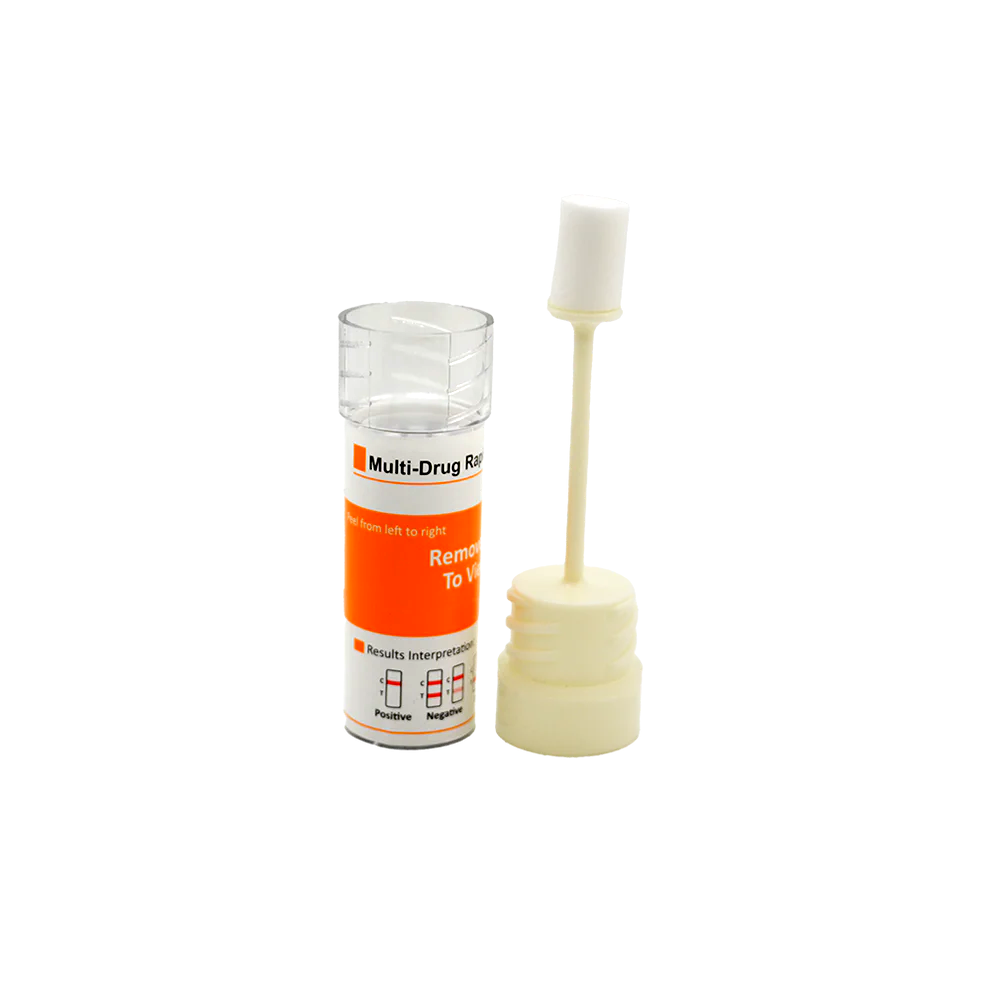
Modern oral fluid screening devices are highly accurate, with individual membrane accuracy typically in the region of 97–99% against laboratory GC/MS. That accuracy figure assumes one thing, however: that the device has been given an adequate sample.
It is not simply a matter of wiping the swab around the mouth, as many people assume. The collection sponge needs to be genuinely saturated with saliva so that there is enough oral fluid to run every test line in the device. If the sample is inadequate, the test will not run at all, and you will get no result rather than a wrong one.
Cannabis makes this even more important. Saliva kits can detect the parent THC compound sitting in the oral cavity,but principally detect the metabolites in the oral cavity which take up to 20 minutes to be in sufficient concentration after a single TC exposure, so the swab has to physically collect those residues from the surfaces of the mouth. A sponge that has simply been dipped in a pool of spit will not pick them up. You can read more about this on our cannabis saliva detection times page.

Which test designs that this technique applies to
The method below works with both main families of oral fluid device, though it matters most with the direct designs, which begin running the moment they are introduced into saliva and cannot easily be moved around the mouth once collection has begun.
| Design | How it works | Why technique matters |
| Direct saliva (DSD-863 family) | The device itself goes into the mouth and starts running as soon as it contacts saliva. No sample handling or transfer. | Highest. You get one attempt, and the test begins immediately, so all the preparation has to happen beforehand. |
| Swab and barrel (DSD-877, DSD-8117) | A sponge collector is saturated in the mouth, then screwed down into a barrel that releases the sample across the membranes. | High. The lid will not screw down properly unless the sponge is wet enough, which invalidates the result. |
| Separate swab on a stick (DSD-865) | A swab collects the sample, which is then applied to a separate test panel. | Moderate. You have more control during collection, but volume is still the limiting factor. |
You can browse the full range of designs across our saliva drug test kits and multi-panel saliva drug test kits collections.
Rule 1: Nothing in the mouth for 20 minutes
Do not start sampling or collection until 20 minutes have elapsed since anything was last in the mouth. No eating, no drinking, no smoking, no vaping. Absolutely nothing. No rinsing, no mouthwash, no chewing gum, no mints. Nothing at all.
This matters for two separate reasons. Food residue, drink, sugar and flavourings can interfere with how the membranes run and can leave debris that blocks the flow of fluid through the device. Just as importantly, the 20 minute pause gives the donor's natural saliva flow time to re-establish itself, which is exactly what you need for a good volume sample. If the drug test includes a saliva alcohol test, again 20 minutes allows any alcohol, recently consumed to evaporate and be cleared from the mouth, so the indicator only measures alcohol coming from the blood stream into the fresh saliva. This gives an accurate real time measure of the blood alcohol level.

Worth knowing: the 20 minute wait does not reduce your chance of detecting cannabis. It actually enhances the detection. It is rinsing, eating and drinking that wash THC residues out of the oral cavity, not the passage of time alone. Simply waiting with an empty mouth leaves those residues where the swab can collect them.
Rule 2: Ask the donor to do the following before inserting the test swab
Instruct the donor to lick the outside of the top teeth from molar to molar 3 times. Repeat with the bottom teeth. Ask the donor to lick the inside of the top teeth 3 times, repeat with the bottom teeth. Ask the donor to put the tongue into the right cheek and lick all around, repeat on the left. Ask the donor to lick the roof of the mouth 3 times. Ask the donor to lick the floor of the mouth and up the bottom teeth to form a pool of saliva. Ask the donor to introduce the collection swab into the pool of saliva and feed further saliva onto the swab for 45-60 seconds.
Rule 3: Repeat the actions in rule 2 using the test swab Wipe
Before you think about volume, think about coverage. Wipe the collector thoroughly around the whole of the oral cavity: between the teeth and gums on both the upper and lower jaw, along the inside of both cheeks, and across the top and underside of the tongue.
This step is what physically lifts drug residues off the surfaces of the mouth and onto the sponge. Skipping it is the single most common reason a screen misses recent cannabis use, because those residues sit on the tissues of the mouth rather than dissolved evenly through the saliva.
Take your time over it. Fifteen to twenty seconds of deliberate wiping is not excessive.
Rule 4: Let the saliva pool, then saturate the collector before removal
Once you have wiped the oral cavity, ask the donor to gather saliva under and around the tongue for a few moments rather than swallowing it. Then hold the collector in that pool for roughly 35 to 45 seconds, allowing the sponge to draw the fluid up.
Asking the donor to work their jaw gently, or to think about food, will usually stimulate flow if they are running dry. Do not be tempted to offer water to help things along, as that resets the 20 minute clock entirely.
Rule 5: Saturate the sponge completely
The sponge should be soft, heavy and visibly wet before it goes anywhere near the device. This can take up to two or three minutes, and that is entirely normal.
With swab and barrel designs you have a built-in check: pop the collector into the barrel and screw it down. If it will not screw right down and seat tightly, there is not enough saliva on the sponge. Forcing it or accepting a loose fit will produce an invalid result.
With direct designs, make absolutely certain the protective cover has been removed before the device goes into the mouth. A covered device cannot absorb any fluid at all, and this is a surprisingly frequent cause of tests being reported as faulty when they are simply still capped.

Rule 6: Re-insert the collector if you are short
A partially saturated sponge is not a lost cause. On swab and barrel kits the collector can be taken back out and returned to the mouth for a few more seconds to pick up additional saliva, then re-seated. There is no penalty for doing this, and it is far better than proceeding with a marginal sample.
The same principle applies once the test is running. If no control lines appear in the result windows, that is almost always a volume problem rather than a faulty device. Where the design allows it, collect more saliva and try again.

Rule 7: Tap out the air bubbles
Air bubbles trapped against the membranes will physically block fluid from reaching the reagents, which can stall a test that otherwise had plenty of sample. Tapping the device firmly on a hard, flat surface once the sample has been introduced breaks those bubbles and lets the fluid travel properly.

It is a small step that takes two seconds and rescues a meaningful number of otherwise wasted kits.
Extra care with combination drug and alcohol kits
Everything above matters more as the panel size grows. A six drug screen has modest sample demands. An eleven or thirteen panel device with an alcohol strip alongside it has to distribute a single collection across a great many reaction sites, and the alcohol element in particular needs good contact with fresh saliva to read reliably.
If you are running drug and alcohol saliva test kits or any of the larger combinations, treat the two to three minute collection as the standard rather than the exception. Our eleven panel workplace and driver kit is a good example of a device where sample volume is the difference between a clean read and a repeat test.

Reading the result: control lines and faint lines
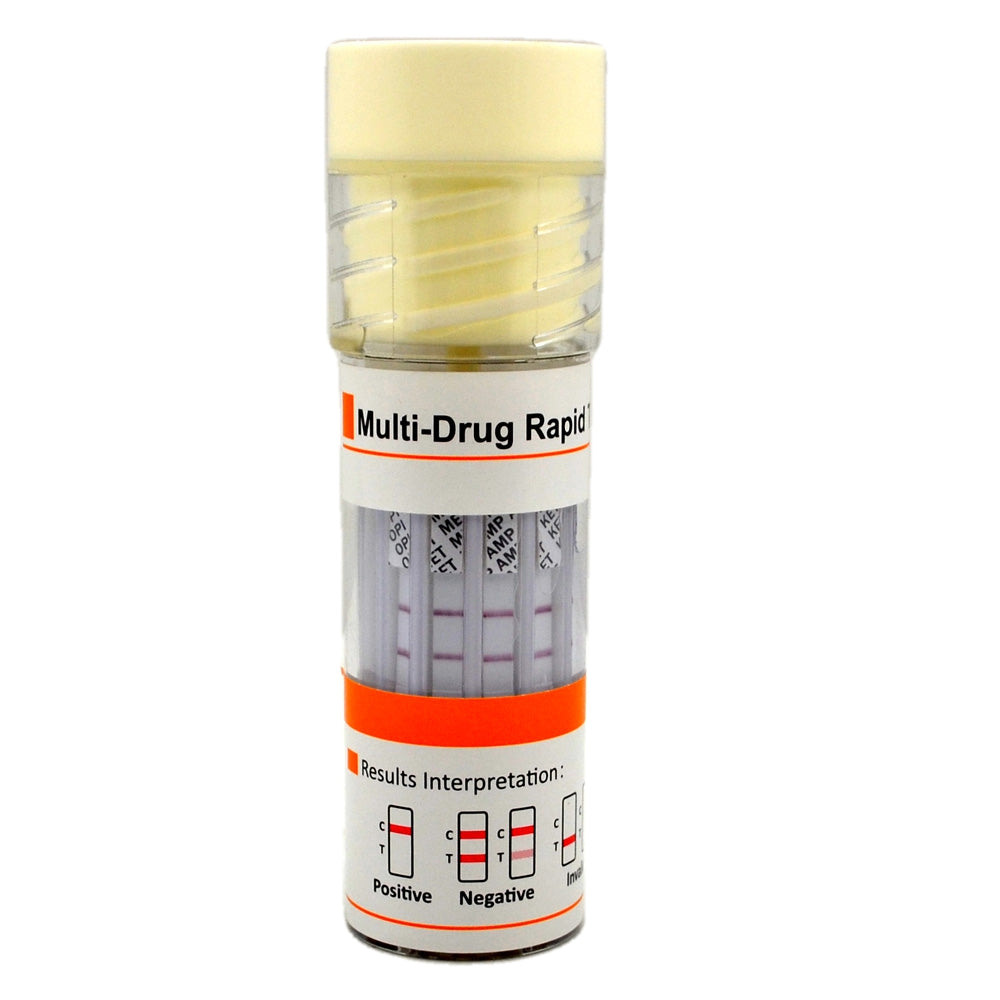
Wait for the control lines to form before you read anything. Once every control line is visible, the device has absorbed enough fluid to have run correctly. Read the result at the time stated in the instructions supplied with your kit, typically five or ten minutes depending on the design.
Faint lines cause more confusion than anything else in point of care screening. A faint line in a test window does not indicate a positive result. Any visible line, however pale, is read as negative for that drug group. A result is only treated as non-negative when the control line is present and there is no line or shadow at all in the test window.
If you are unsure what you are looking at, our guides on how to read drug test results and faint lines on a drug test walk through the common scenarios with examples.
Common saliva sampling mistakes

Key takeaway: almost every "failed" saliva test we are asked about turns out to be a collection problem rather than a device problem. Twenty minutes of nothing in the mouth, a thorough wipe around the oral cavity and a properly saturated sponge will resolve the overwhelming majority of them.
What to do with a non-negative result
Rapid oral fluid devices are screening tests. A non-negative screen is an indication for further action, not a finding of fact, and it should never be the sole basis for disciplinary proceedings.
Any non-negative screen should be confirmed using an accredited evidential method before any decision is taken. Our laboratory confirmation drug test packs provide the chain of custody paperwork and sample containers needed for this step, and our guide to workplace drug and alcohol testing procedure sets out how the process should run from consent through to confirmation.
Watch the technique demonstrated
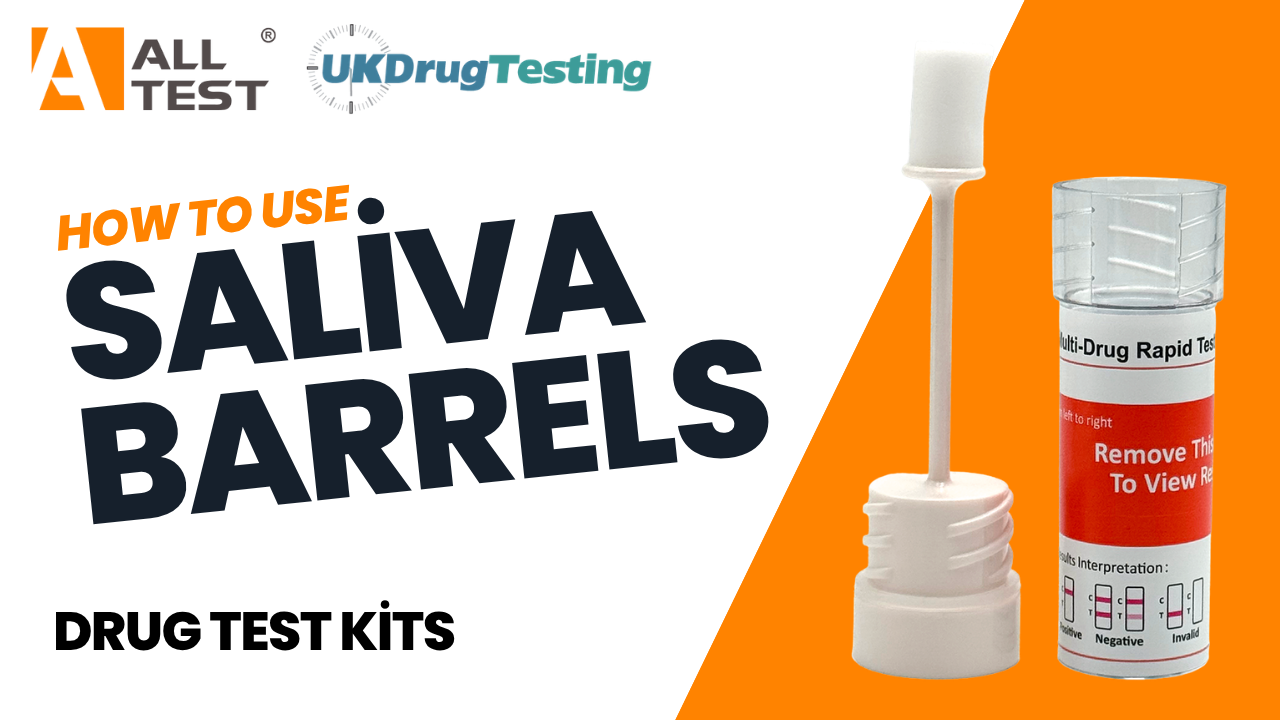
The video below runs through a full collection on an ALLTEST saliva kit, including the swab technique and how the collector seats into the barrel.
Frequently asked questions
How long should collection actually take?
Budget for two to three minutes from the moment the collector enters the mouth. Anything much faster than that usually means the sponge is not properly saturated.
Can the donor drink water to help produce saliva?
No. Water in the mouth restarts the 20 minute waiting period and dilutes the sample. If the donor is genuinely dry, allow more time and encourage gentle jaw movement instead.
What if the donor claims they cannot produce saliva?
Give them longer. Persistent inability to produce a sample after a reasonable period should be recorded and handled under your organisation's drug and alcohol policy, in the same way as any other refusal or failure to provide.
Does the 20 minute rule apply to water alone?
Yes. Anything entering the mouth resets the clock, including plain water and rinsing.
Can I reuse a collector or re-run a device?
No. These are single use devices. If a test runs invalid, discard it and start again with a fresh kit.
Where can I see the technique demonstrated?
Our ALLTEST DSD-8 saliva drug test kit page includes a full video demonstration and downloadable instructions, and all of our current instruction sheets are collected on the drug testing kit instructions page. Employers running regular programmes may also find our online drug test training useful.
The information in this article is provided for general educational purposes only. It is not a substitute for the instructions for use supplied with your test kit, and you should always read those instructions before conducting any test.
Rapid oral fluid devices are screening tests. A non-negative screening result is not confirmation that a drug is present, and it should not be used as the sole basis for disciplinary or legal action. All non-negative results must be confirmed by an accredited laboratory using an evidential confirmation method before any decision is taken.
Detection windows and sensitivities vary between products, between individuals and between substances. Employers should ensure that all testing is carried out with informed consent, in line with a written drug and alcohol policy, and in accordance with current UK employment law and data protection requirements.
UK Drug Testing supplies drug testing products and information to support awareness and responsible decision-making. If you have concerns about your own or someone else's drug use, please speak to a healthcare professional.