
Drug Test Results

How to read drug test results

The results of a drug test can be either positive or negative. A positive result indicates that drugs were detected in the sample, while a negative result indicates that no drugs were detected. If the test is positive, further testing may be necessary to confirm the results. 

A negative drug test result

If you just get a Control line (C) and a Test line (T) on a drug test kit result within the specified time then this is a negative drug test result.  ie no drug detected

A positive drug test result

If you just get a Control line (C) but no Test line (T) on a drug test kit result within the specified time then this is a positive drug test result.

The image below shows two drug test results.

  • The first result is positive ie the C line is present and the T line is absent.
  • The second result is negative ie the C line is present and the T line is present. 
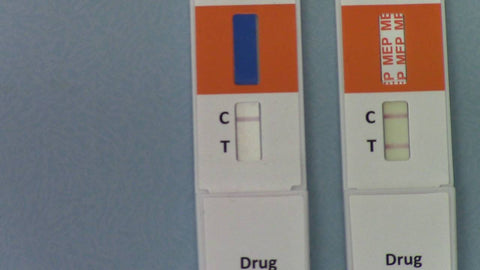
drug test results positive and negative


Faint T line on drug test result 

A faint T line with a visible C line is always a negative drug test result ie no drugs were detected above the cut-off levels for the drug test, on the sample being tested, as long as the line appeared within the read time for the particular drug test kit that you are using.

More information on how to interpret a faint line on a drug test result

What is an invalid drug test result?

If there is no C line and no T line this is an invalid drug test result. The most common reason for an invalid result on a drug test kit is insufficient specimen. The sample provided for testing may be too small in volume to conduct a valid drug test. This is more common in saliva testing than in urine testing.

Another possible reason is that you have not removed the cover from the drug test kit which means it is unable to absorb the sample. Most urine panel tests and direct saliva drug test kits have a cover which needs to be removed before the drug test kit can be used. 

Drug test codes on drug test kits and what do the abbreviations mean?

Drug tests commonly use various abbreviations to refer to different substances, including:

  1. THC - tetrahydrocannabinol (the primary psychoactive component in Cannabis also known as marijuana , weed )
  2. MDMA - 3,4-methylenedioxymethamphetamine (also known as ecstasy)
  3. KET Ketamine
  4. COC - cocaine
  5. AMP - amphetamines (such as methamphetamine and Adderall)
  6. MOP - opioids (such as heroin, codeine)
  7. OPI - opioids (such as heroin, morphine, and oxycodone)
  8. BZO - benzodiazepines (such as Valium and Xanax)
  9. MET - methamphetamine
  10. TML Tramadol
  11. BAR - barbiturates (such as phenobarbital and secobarbital)
  12. TCA - tricyclic antidepressants (such as amitriptyline and nortriptyline)
  13. PPX - propoxyphene (an opioid pain medication)
  14. BUP - buprenorphine (a medication used to treat opioid addiction)
  15. FEN - fentanyl (a powerful synthetic opioid)
  16. MTD - methadone (a medication used to treat opioid addiction)
  17. OXY - oxycodone (an opioid pain medication)
  18. K2 - synthetic cannabinoids (also known as "Spice" or "K2"
  19. GHB (gamma-hydroxybutyrate)
  20. GAB-Gabapentin
  21. CNB Cannabinol
  22. DCA Cathinone
  23. CFY Carfentanyl
  24. EDDP  2-ethylene-1,5-dimethyl-3,3-diphenylpyrrolidine is a  metabolite of methadone
  25. MPR Meperidine
  26. MEP Mephedrone
  27. MQL Methaqualone
  28. MDPV Methylenedioxypyrovaleron
  29. ETG Ethylglucuronide ( a by product of alcohol)
  30. PGB Pregabalin
  31. PCP - phencyclidine (a hallucinogenic drug)
  32. LSD - lysergic acid diethylamide (a hallucinogenic drug)
  33. TZD Trazadone
  34. ZOL Zolpidem

It is important to note that different drug tests may use different abbreviations and codes, and some substances may have multiple abbreviations depending on the context. If you have questions about the specific abbreviations used on a drug test kit, it is best to consult with the drug testing kit provider. It's also worth noting that the specific abbreviations used on a drug test may vary depending on the testing company or laboratory, and some tests may use more detailed abbreviations that specify the specific metabolites or compounds being tested for. If you're unsure about what a specific abbreviation means on a drug test result, it's best to consult with the drug testing provider.

Information on detection levels, sensitivity of drug test and detection times on different urine and saliva drug tests is here

If you wish to purchase a drug test kit you may find our drug test quiz helpful to help you choose the best drug test for you.

Collapsible content

Can drug test results vary depending on the time of day?

Yes. Drug concentrations in urine or saliva can fluctuate throughout the day depending on hydration levels, metabolism, and recent intake of food or fluids. For the most consistent results, testing at a similar time (often first urine of the day is the most concentrated) is recommended.

Do drug tests measure how much of a drug is present?

Rapid drug tests are qualitative, not quantitative. They only indicate whether a substance is above or below a set cut-off level, not how much is present.

To measure how much of a drug is present you need to do a laboratory drug test.

What are cut-off levels in drug testing?

Cut-off levels are pre-set thresholds used to determine whether a result is positive or negative. If the drug concentration is below the cut-off, the result is negative; if it is above, the result is positive.

Can hydration affect drug test results?

Yes. Drinking large amounts of fluids before a test may dilute the sample, potentially lowering drug concentrations. However, many professional workplace drug testing kits now include checks for dilution to ensure reliability.

Should I repeat a drug test if I’m unsure about the result?

If the result is unclear, invalid, or you suspect an error (e.g. incorrect timing or insufficient sample), it’s best to repeat the test using a new kit. Always follow the instructions supplied with the drug test kit, and make sure you have obtained an adequate sample, to run all the test membranes. This is particularly important with saliva drug testing.

Can medications cause false positive results?

Some prescription or over-the-counter medications can cross-react with drug tests and produce a false positive. If this is a concern, confirmatory laboratory testing is recommended.

What is confirmatory drug testing?

Confirmatory testing (usually carried out in a laboratory using methods like LC-MS/MS or GC-MS) is used to verify initial positive results. It provides a highly accurate and legally defensible result. Order a confirmatory drug test lab pack.

How important is the test read time?

Very important. Results must be read within the time stated in the instructions. Reading too early or too late can lead to inaccurate interpretation.

Can a drug test result change after the read time?

Yes. Drug test results read after the recommended time may show changes (such as evaporation effects), which are not valid. Always follow the manufacturer’s timing guidance.

Why do different drugs show different line intensities?

Each drug panel has different sensitivities and reacts differently with the sample. Variations in line intensity are normal and do not affect whether the result is positive or negative.

Can environmental factors affect drug test results?

Extreme temperatures, expired test kits, or improper storage can affect performance. Always store drug tests as instructed and check expiry dates before use.

What should I do if I suspect tampering?

If you believe a sample has been tampered with (e.g. dilution, substitution), you should:

  • Repeat the test under supervised conditions.
  • Consider laboratory confirmation
  • Follow your organisation’s drug testing policy

Are drug test results legally binding?

Instant drug test results are considered screening results. For workplace or legal purposes, any non-negative result should be confirmed by a certified laboratory drug test before action is taken.

Do all drug tests work the same way?

Most rapid drug tests use lateral flow technology, but formats vary (urine cups, multi-panel dip cards, saliva tests). Always follow the specific instructions for the drug test kit you are using.

How long do drugs stay detectable in the body?

Detection times vary depending on the substance, frequency of use, and metabolism. For example:

  • Cannabis: up to several days (longer for frequent users)
  • Cocaine: 1–3 days
  • Opiates: 1–3 days

Different drug testing methods (urine, saliva, hair) will have different detection windows.

Detailed information on drug test detection times